
A mid-market company had everything in place. Quotas were set. Comp plans were designed. The sales team was fully staffed. Then the numbers came in. Half the reps were blowing past 100% attainment year after year. The other half couldn’t crack 50%. Leadership called it a performance problem. They coached. They shuffled territories. They restructured comp. Nothing moved.
It looked like a talent gap. But when we pulled the data apart, the real cause was structural: quotas were built on a segmentation model that didn’t know who the right customers were. The reps who were failing weren’t less skilled. They’d been assigned accounts that were never going to close.
This pattern shows up constantly in mid-market, PE-backed companies. Teams assume the problem is execution when the real problem is the operating foundation underneath it. Segmentation is that foundation. When it’s wrong, everything built on top of it inherits the error: quotas, territories, comp, coverage, marketing spend. The failure compounds silently across functions until someone finally asks why the numbers don’t work.
The answer is almost never more data. Most companies already have what they need. The problem is how the model is designed, whether it connects to daily operations, and whether anyone enforces it.
Why This Is Getting Worse, Not Better
Two shifts are making segmentation failures more costly than they were five years ago.
First, PE-backed companies face more pressure to show efficient growth. Operating partners and boards are scrutinizing GTM efficiency, not just top-line revenue. A segmentation model that sends reps to low-conversion accounts doesn’t just waste time. It inflates customer acquisition cost, compresses margins, and makes the growth story harder to defend at exit.
Second, buying behavior has fragmented beyond what size-based models can capture. A $200M manufacturer and a $200M SaaS company buy differently, need different things, and move at different speeds. Revenue band alone no longer predicts deal velocity, product fit, or expansion potential. Companies that still segment on size are making resource allocation decisions with outdated assumptions.
Four Design Flaws That Kill Segmentation Before It Starts
1. Definitions are subjective, so every rep builds their own model.
Ask two reps on the same team to classify the same account. If they give different answers, the model is already broken. Most models rely on loose labels like “Strategic,” “Core,” or “Growth” without objective rules behind them. No measurable thresholds. No consistent logic.
There’s a deeper misconception driving this. Many executive teams confuse ICP with buyer persona. ICP defines the type of company you should target. Buyer persona defines the person within that company you should reach. These are two separate exercises. When they get merged, segment definitions collapse into vague descriptions that mean something different to every person on the team. Without crisp, behavior-based definitions, reps revert to gut feel and managers hand out exceptions like candy.
2. Size is the only variable, and size doesn’t predict buying behavior.
Most mid-market companies stop at revenue, employee count and annual spend. But revenue and headcount are blunt instruments. Effective models incorporate business model, industry dynamics, technology adoption, use cases, product alignment, and growth potential. The data for these dimensions already exists in most companies’ databases. Demandbase, Rev, Pitchbook, and similar tools have far more information than most teams are pulling. In 99% of cases, the database you already have is more than sufficient.
A size-only model buries strategic opportunities under accounts that look right on paper but will never convert. Reps chase deals that were never going to close. Low-value accounts get disproportionate attention. It’s the equivalent of sorting a library by spine color and wondering why nobody can find the right book.
3. The model lives on a slide, not in the operating system.
This is where most segmentation projects go to die. The strategy team builds a model, presents it in a deck, and moves on. Nobody connects it to how the go-to-market team actually works. A real segmentation model changes coverage, service levels, quotas, territories, and messaging by segment. If none of those change, the exercise was academic.
The cascading cost is significant but quiet. When segmentation isn’t operationalized, quotas don’t reflect segment potential. Comp design stops making sense because it can’t reward what it can’t accurately measure. Marketing spends budget targeting everyone instead of the accounts most likely to convert. Each of these failures traces back to the same root: the model was designed to explain, not to operate.
4. The CRM doesn’t enforce the rules, so the model decays within weeks.
If segmentation lives outside the CRM, reps default to old habits fast. Accounts get misclassified. Tiering becomes inconsistent. Manual spreadsheet updates introduce drift. Within a quarter, the model is fiction. The gaps are predictable: no field structures for segmentation criteria, no automated scoring, no alerts when accounts shift between tiers, no required fields at account creation, and no reporting tied to segment performance.
This problem is getting easier to solve. With AI now embedded in CRM tools, segmentation can be refreshed in real time. Instead of rebuilding segments once a year, the system updates rankings as company data changes. Prospects move up or down based on live signals. What used to be an annual project can now run continuously.
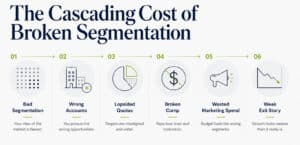
What Broken Segmentation Actually Costs
The cost doesn’t show up as a single line item. It shows up everywhere, and it looks different depending on where you sit.
For sales leadership, it means lopsided attainment. Some reps consistently overperform because they were assigned to the right accounts by luck. Others consistently underperform because they’re working accounts with low propensity to buy. The variance looks like a coaching problem. It’s a model problem.
For finance, it means comp plans that don’t correlate with effort or skill. Reps in high-potential segments earn more not because they’re better, but because the assignment was better. That misalignment erodes trust and inflates cost.
For marketing, it means diluted ROI. Without clear segment definitions, campaigns target everyone. Budget spreads thin. Conversion rates stay flat because the audience includes accounts that will never buy. Once segmentation is fixed, marketing can direct spend at the right prospects and stop lighting money on fire.
For the operating partner or board, it means the growth story is harder to defend. GTM efficiency metrics all suffer when the underlying account assignment is wrong. At exit, that shows up in the multiple.
How to Fix It: Four Decisions in the Right Order
Fixing segmentation requires discipline, not complexity. Four decisions, made in sequence.
Start with data quality. Look at your data fill rates. Check your customer list and assess how complete each field is. A segmentation exercise is a data exercise. If the data isn’t clean, the model won’t hold. Most teams skip this step and pay for it later.
Define segments using multiple dimensions. Pull firmographic attributes, behavioral signals, and product-fit indicators from your existing database. Check for correlations. Build scoring criteria that are objective enough for any rep to apply the same way. No special tools required.
Connect segments to the operating model. Define how coverage, service levels, quotas, territories, and messaging change by segment. This is where the work gets real. If the sales team is still working the same way after the segmentation exercise, the exercise failed.
Enforce it in the CRM. Set up automated scoring, required fields, workflows, and dashboards. Make segmentation a system that maintains itself. With AI-enabled CRM, accounts move up or down as data changes, without waiting for an annual review.
What Changes When the Model Is Right
When segmentation becomes an operating system instead of a classification exercise, the impact compounds across the business. Reps spend time on accounts with real potential. Attainment evens out because the underlying assignment is sound. Comp plans reward the right behavior. Marketing directs spend at accounts that can actually convert. Win rates climb. Expansion revenue grows. Most companies already have the ingredients. The data exists. The tools are in place. What’s missing is a model designed to operate, not just to explain. The companies that figure this out first don’t just sell more efficiently. They build a compounding advantage that gets wider every quarter.
Assess Your Segmentation Model
If your team is seeing lopsided attainment, flat marketing ROI, or quotas that don’t reflect actual account potential, the issue is upstream of where you’re looking.
Cortado Group helps mid-market companies build segmentation models that are objective, operational, and enforced in the CRM from day one. Reach out for a segmentation diagnostic and see where your model is breaking.